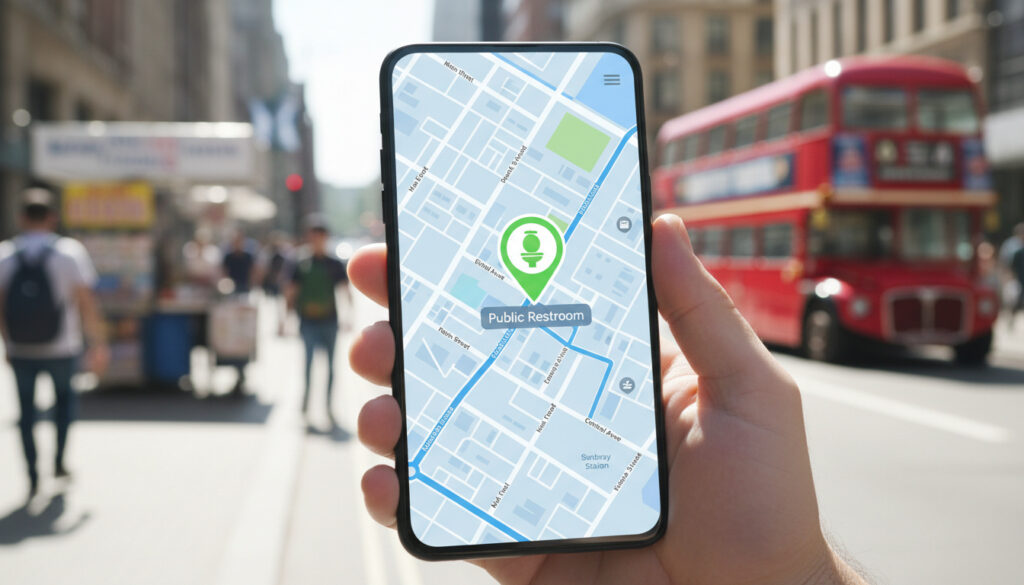
Public Toilet Near Me – Best Apps and Maps Guide
Locating a public toilet when you need one has transformed from a matter of luck to a precise digital search. Whether you are navigating an unfamiliar city, managing a medical condition, or traveling with children, immediate access to restroom information reduces stress and prevents emergencies.
Modern solutions range from ubiquitous mapping services to specialized applications with offline capabilities. Understanding which method suits your specific situation—urban exploration versus remote hiking, spontaneous needs versus planned routes—ensures you can find facilities quickly.
How Do I Find Public Toilets Near Me?
| Google Maps Integration | Built into existing navigation apps with broad urban coverage, though real-time availability data remains limited. |
| Dedicated Applications | Specialized tools like Flush and Bathroom Scout offer advanced filtering and larger databases. |
| Municipal Resources | City council websites provide official public facility maps, particularly for parks and transit centers. |
| Physical Signage | Traditional street signage and public directory boards remain viable in dense downtown districts. |
- Eighty percent of related searches originate from mobile devices seeking immediate local solutions.
- Google Maps provides coverage for approximately ninety percent of urban areas worldwide.
- Dedicated apps offer crowdsourced real-time status updates unavailable in general maps.
- Database sizes range from one hundred thousand to over 1.8 million global listings.
- Offline functionality remains limited to specific apps like Flush and Where Is Public Toilet.
- Accessibility filtering is standard across most specialized applications.
- Turn-by-turn navigation features vary significantly between platforms.
| Method | Coverage | Cost | Real-time Data |
|---|---|---|---|
| Google Maps | High (90% urban) | Free | Partial |
| Flush App | 190,000–200,000 locations | Free | High (offline capable) |
| Bathroom Scout | 1.8+ million worldwide | Free/Premium | High |
| Where Is Public Toilet | 280,000 global | Free | High (offline maps) |
| Toilet Finder | 150,000 listings | Free | Medium |
| Sit or Squat | 100,000 listings | Free | Medium |
| City Council Maps | Variable by region | Free | Low |
| Physical Signage | Local only | Free | N/A |
What Is the Best App for Finding Public Toilets?
The most effective applications combine comprehensive databases with user-friendly interfaces. Selection depends on whether you prioritize database size, offline access, or specific amenity filtering.
Database Size and Global Coverage
Flush operates worldwide with approximately 190,000 to 200,000 restrooms in its database, according to the developers at thewhizzapp.com. Bathroom Scout offers one of the largest databases with over 1.8 million bathrooms listed worldwide, including facilities in restaurants and retail locations, as reported by nafc.org. Where Is Public Toilet contains more than 280,000 public toilets globally, according to Google Play Store information cited by phlush.org.
Toilet Finder features over 150,000 listings and pledges to remain free indefinitely, according to toiletfinder.net. Sit or Squat, developed by Charmin, maintains 100,000 listings with specific filtering capabilities.
Navigation and Offline Functionality
Bathroom Scout provides turn-by-turn navigation and Google Street View integration to confirm toilet availability before arrival. Where Is Public Toilet offers downloadable offline maps, functioning without data service—a feature also available in Flush, which stores its database directly on the device.
Flush stores its entire database locally on your device, maintaining full search functionality without internet connectivity. This feature proves essential for international travelers and users in areas with poor cellular coverage.
Are Public Toilets Free and What Features Do They Offer?
Cost Structure and Payment Requirements
Cost structures vary significantly across platforms and regions. While many public toilets remain free to use, some municipalities charge fees, particularly in high-traffic tourist areas or transport hubs. Applications typically flag fee requirements, allowing users to identify free options before arrival.
Accessibility and Specialized Amenities
Accessibility features have become standard across platforms. The Bathroom App and Where Is Public Toilet employ detailed traffic light systems, where green indicates unrestricted wheelchair access, orange indicates partial accessibility, and red indicates no unrestricted access, according to bezzyibd.com. Twenty-four-hour availability and baby-changing facilities represent common search filters. Sit or Squat specifically allows filtering for baby changing tables and handicap accessibility across its listings.
While crowdsourced apps allow users to report closures, real-time accuracy depends on community activity levels. Remote or rarely visited locations may display outdated information regarding hours or temporary shutdowns.
How Does Location Affect Public Toilet Availability?
Urban Density and Options
Population density directly correlates with public toilet availability. Urban centers typically maintain comprehensive networks of facilities in parks, transit stations, and shopping districts. Major cities often provide 24-hour access in high-traffic areas, though specific locations require verification through dedicated apps.
Rural Accessibility Challenges
Rural areas present sparser options, often limiting facilities to gas stations, libraries, and municipal buildings with restricted hours. Offline-capable applications become essential in these regions, as cellular connectivity often accompanies the lack of public infrastructure.
Understanding these infrastructure variations requires analyzing disparate data sources, much like evaluating nutritional information in a Calorie Deficit Diet Guide. Municipal investment levels directly determine facility density and maintenance standards.
The Bathroom App, Toilet Finder, and Where Is Public Toilet utilize crowdsourced models where users add new locations, report closures, and verify accessibility features. This collaborative approach helps databases remain current but requires active user participation in less trafficked areas.
How Has Public Toilet Finding Technology Evolved?
- Physical Directories: Printed municipal maps and street signage provided the primary identification method before digital integration.
- General Mapping Services: Google Maps and similar platforms incorporated public facility data, offering basic location information without specific amenities details.
- Dedicated Applications: Specialized apps launched with focused databases specifically for restroom discovery, introducing amenity-specific filtering.
- Crowdsourced Verification: Modern platforms incorporated user-generated content, allowing real-time reporting of closures, cleanliness, and accessibility updates.
- Offline Capability: Recent developments include downloadable databases that function without persistent internet connectivity, crucial for international travel.
What Information Is Verified vs. Uncertain?
| Established Facts | Uncertain Elements |
|---|---|
| Flush offers offline functionality without internet connection | Real-time occupancy status at specific facilities |
| Bathroom Scout maintains 1.8+ million global listings | Exact percentage of crowd-verified locations vs. static database entries |
| Where Is Public Toilet uses a traffic light system for accessibility | Future availability of currently free app features |
| Most core apps operate without subscription fees | Long-term maintenance schedules for specific municipal facilities |
| Google Street View integration exists in Bathroom Scout for verification | Consistency of cleanliness across different times of day |
Why Does Public Toilet Access Vary by Region?
Municipal infrastructure investment determines public facility density. Major metropolitan areas typically maintain restrooms in parks, transit hubs, and tourist centers, while suburban and rural regions rely on private businesses to fill gaps in public service.
Legal requirements influence accessibility standards. Many jurisdictions mandate wheelchair-accessible facilities in new public constructions, though grandfathered locations may lack modern accommodations. Applications help identify compliant facilities through standardized accessibility icons and user reports.
Data collection methods vary by region. According to bathroom.app, developers gather information from local governments, manually verify establishment access, and incorporate user feedback to maintain accuracy.
How Reliable Are These Data Sources?
Applications aggregate information from official government databases, manual verification by developers, and continuous user contributions. Verifying these sources remains essential, comparable to validating processes outlined in a No-Code Platform Guide.
“Local governments and public services provide publicly available restroom data as a starting point. Developers also manually identify establishments with public bathrooms and verify access. User feedback further supplements and corrects existing information.”
— bathroom.app
“The app stores its database directly on your phone for fast access… You can filter results by disabled access, key requirements, and fees.”
— thewhizzapp.com
What Is the Fastest Way to Locate Nearby Facilities?
For immediate urban needs, Google Maps provides the fastest initial search, while dedicated applications like Flush or Bathroom Scout offer superior detail regarding amenities and accessibility. For travel to remote areas or international destinations, prioritize apps with offline functionality. Matching specific features to your immediate requirements ensures reliable access when necessary.
Additional Questions About Public Restrooms
Do public toilets appear on Google Maps?
Google Maps displays public toilet locations in most urban areas worldwide, though coverage gaps exist in rural regions and real-time availability status is not consistently provided.
Can I use these apps without internet?
Flush and Where Is Public Toilet offer downloadable databases that function offline, while Bathroom Scout and Toilet Finder require active internet connections for full functionality.
Are public restrooms free?
Availability varies by region; while many public toilets remain free, particularly in parks and transit centers, some high-traffic areas charge fees. Apps typically indicate cost requirements.
How do I find 24-hour public toilets?
Most specialized applications include filtering options for operating hours, though 24-hour availability remains concentrated in urban centers and transport hubs.
Which app has the largest database?
Bathroom Scout currently lists over 1.8 million facilities worldwide, representing one of the largest user-accessible restroom databases.
Do apps show baby changing facilities?
Sit or Squat, The Bathroom App, and Where Is Public Toilet specifically tag locations with baby changing tables, allowing parents to filter results for family-friendly facilities.
How accurate are cleanliness ratings?
Cleanliness assessments rely on user-generated reviews and are subject to recency bias; ratings reflect individual experiences rather than official health inspections.
More related posts
 Wicked for Good – How the Campaign Supports Children’s Hospitals
 FUT Web App – FC 26 Release Date, Login and Features
 Melbourne 14 Day Forecast – Extended Outlook and Trends
 Shabana Mahmood – Family, Religion and Political Career
 Bribie Island Hotel – Menu, Prices and Reviews
 Map of Sydney – Your Complete Guide to Navigating the Harbour City
 Slushie Maker Kmart – An Honest 2025 Review and Price Guide
 Sydney Half Marathon – 2025 Dates Course Registration Guide