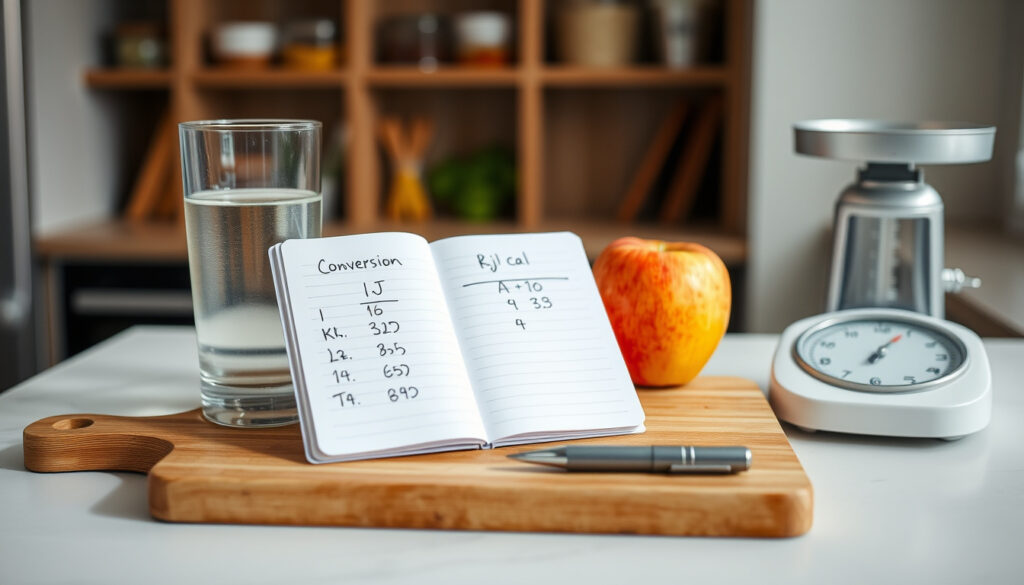
Kj to Cal – Quick Conver ion Guide with Table
A food label in Sydney shows 870 kJ per serve. A fitness app from the United States lists the same snack as 208 Calories. The numbers look different, but the energy is identical. Understanding how kilojoules and calories relate to each other is essential for anyone comparing international nutrition labels, following a meal plan written in a different unit, or simply trying to make sense of daily energy targets.
The link between the two units is fixed by science. One dietary Calorie (kcal) equals exactly 4.184 kilojoules. That single number is the foundation of every conversion calculator, every nutrition table, and every dietary guideline that spans countries using different measurement systems.
Because Australia and New Zealand mandate kilojoules on packaged foods while the United States and Canada use Calories, anyone travelling, ordering imports, or following an overseas diet plan needs a reliable way to switch between them. The following sections explain the conversion formula, provide a reference table, clarify common confusion, and offer practical guidance for everyday use.
How to Convert Kilojoules to Calories: Simple Formula and Steps
A kilojoule (kJ) is a metric unit of energy, commonly used in food labeling in Australia and New Zealand.
A calorie (cal) is a unit of energy; food calories (kcal) are used in the US and many other countries.
1 calorie (kcal) = 4.184 kJ. To convert kJ to cal, multiply kJ by 0.239. To convert cal to kJ, multiply cal by 4.184.
For a rough estimate, divide kJ by 4 (or multiply by 0.25) – not exact but useful for quick mental math.
Key Insights About Kilojoule and Calorie Conversion
- The exact conversion factor is 1 kcal = 4.184 kJ, but many diets use 4.2 for simplicity.
- Australia mandated kilojoules on food labels in the 1990s, while the US uses calories – understanding both is key for international travellers.
- A 2000 kJ daily intake is roughly 478 calories (using 4.184), but typical daily recommendations are around 8700 kJ (about 2080 cal) for adults.
- Most online converters use the 0.239 multiplier; precision matters for accurate tracking but for most people rounding is sufficient.
- 1 kJ = 0.239 calories (kcal) and 1 calorie (kcal) = 4.184 kJ are the two core facts to remember.
- Australia, New Zealand, and many European countries use kJ on food labels; the US and Canada use calories (kcal).
- Consistency matters more than which unit you choose when tracking daily energy intake.
Conversion Fact Table
| Kilojoules (kJ) | Calories (kcal) |
|---|---|
| 1 kJ | 0.239 kcal |
| 10 kJ | 2.39 kcal |
| 50 kJ | 11.95 kcal |
| 100 kJ | 23.9 kcal |
| 250 kJ | 59.9 kcal |
| 500 kJ | 119.2 kcal |
| 1,000 kJ | 239.0 kcal |
| 2,000 kJ | 478.4 kcal |
| 8,700 kJ | 2,080 kcal |
Values follow the ÷ 4.184 rule and are consistent with published conversion charts from the FAO and nutrition references.
Quick Kilojoule to Calorie Conversion Table (Common Values)
Having a set of pre-calculated conversions saves time when checking labels or planning meals. Below are common kilojoule values and their equivalent in Calories, calculated using the standard factor of 4.184.
1000 kJ in Calories
To convert 1000 kJ to calories, divide by 4.184. The result is approximately 239 Calories. This is a useful benchmark because many packaged snacks and smaller meals fall near this energy level.
2000 kJ in Calories
2000 kJ divided by 4.184 equals about 478 Calories. This value is roughly one-quarter of an average adult daily intake, making it a handy reference point when estimating meal energy.
600 kJ and 1090 kJ in Calories
600 kJ converts to approximately 143 Calories. 1090 kJ converts to roughly 260 Calories. Both figures appear frequently on Australian food labels for items such as energy bars, yoghurts, and ready-to-drink beverages.
2733 kJ in Calories
2733 kJ is approximately 653 Calories. This conversion is useful for larger meal items or when checking the energy content of restaurant meals that publish nutritional data in kilojoules.
For a quick approximation, divide the kilojoule number by 4. The result will be slightly higher than the exact value (about 4.4% over), but the error is acceptable for casual tracking. Alternatively, multiply kJ by 0.24 for a result that is very close to the precise figure.
Calories vs Kilojoules: Understanding the Difference
Many people encounter both units and wonder why two different numbers exist for the same energy. The reason is rooted in measurement history and international standards.
What is the Difference Between a Calorie and a Kilojoule?
A calorie (with a lower-case c) is a small physics unit defined as the energy needed to heat one gram of water by one degree Celsius. A dietary Calorie (with a capital C, also called a kilocalorie or kcal) equals 1,000 small calories. A kilojoule is the metric SI unit of energy, and one kilojoule equals 1,000 joules. The fixed relationship is that one dietary Calorie equals 4.184 kilojoules.
Why Do Some Countries Use Kilojoules Instead of Calories?
Australia and New Zealand began mandating kilojoule labeling on packaged foods in the 1990s, aligning with the metric system. The United States and Canada continue to use Calories (kcal) on nutrition labels. The European Union permits both but kilojoules are typically listed first. These differences matter for anyone consuming imported products or following meal plans written abroad. For a real-world example of how energy labels appear on specific products, see our article on Somersby Apple Cider – ABV, Calories and UK Prices.
Why Nutrition Labels in Australia Show kJ
Food Standards Australia New Zealand (FSANZ) requires energy to be declared in kilojoules per serve and per 100 g. When comparing foods in Australian supermarkets, checking the kJ value is the most direct method. Calories are rarely listed, so converting between units becomes necessary when using overseas dieting apps or US-based nutrition guides.
In nutrition, the word “Calories” almost always means kilocalories (kcal). A food label showing 200 Calories is actually 200 kcal, which equals 837 kJ. Confusing the small calorie (cal) with the dietary Calorie (kcal) would produce a 1000-fold error, so context is vital.
Using a kJ to Cal Converter for Diet and Nutrition
Online converters serve a practical role in daily diet management. Instead of performing mental arithmetic repeatedly, a reliable tool returns accurate values instantly.
Can You Use a kJ to Cal Converter for Diet Planning?
Yes. Diet planning often involves comparing imported labels that use Calories against Australian labels that use kJ. A converter ensures you compare like with like. It also helps when converting meal plans written in Calories into kJ for Australian tracking, or when estimating daily energy intake consistently across different sources.
How Converter Tools Work
Most online converters follow the same logic: input the energy value in one unit, apply the conversion factor of 4.184, and display the result rounded to a convenient number. Some tools offer an option to round to the nearest whole number, mimicking the rounding seen on many nutrition labels. For a specific example of product energy labeling, see our article on Somersby Apple Cider – ABV, Calories and UK Prices.
Accuracy: 4.184 vs 4.2 vs 4.18
The standard scientific conversion factor is 4.184, as cited by the FAO, BUPA Australia, and multiple nutrition references. Some health and fitness websites use 4.2 or 4.18 for simplicity. The difference is small: using 4.2 instead of 4.184 introduces an error of about 0.4%, which is negligible for most dietary purposes.
According to health sources, whether you track in kJ or Calories matters less than staying consistent. Switching between units mid-diet can lead to misjudging portions. Choose one unit, convert all your targets and labels to that unit, and stick with it.
Timeline: How Kilojoules and Calories Became Standard Units
- 1878: The calorie is first defined as a unit of heat and energy in physics and chemistry contexts.
- 1960: The International System of Units (SI) adopts the joule, making the kilojoule the standard metric unit for energy.
- 1990s: Australia and New Zealand mandate kilojoule labeling on all packaged foods, replacing the earlier use of Calories on labels.
- 2016: The US FDA updates nutrition label rules, allowing kilojoules to appear alongside Calories in small print for certain products.
- 2025: Most online converters continue to use the 4.184 factor, maintaining consistency with international scientific standards.
What Is Certain and What Remains Unclear About the Conversion
| Established Information | Information That Remains Unclear |
|---|---|
| One food calorie (kcal) is defined as exactly 4.184 kilojoules for nutrition purposes. | Some sources round to 4.2 for simplification; the difference of 0.4% is negligible for most people but not exact. |
| The conversion formula (kJ ÷ 4.184 or kcal × 4.184) is mathematically fixed. | The definition of “calorie” varies between the small calorie (cal) and the large Calorie (kcal) – always check which is being used. |
| Australia requires kilojoules on all food labels by law. | Different countries may round published values slightly differently (e.g., 4.18 vs 4.184), so minor variations appear on labels. |
Background: Why the 4.184 Factor Exists
The 4.184 factor comes from the thermodynamic definition of the calorie. One calorie was originally defined as the energy required to raise the temperature of one gram of water by one degree Celsius. When the International System of Units adopted the joule, scientists measured the relationship and established that one calorie equals 4.184 joules exactly. For dietary purposes, this same factor scales up: one kilocalorie (1,000 calories) equals 4.184 kilojoules (4,184 joules). Regional labeling laws then determined which unit appears on food packages. In Australia, if a label says “Calories,” it is actually displaying kilojoules due to local regulations. In the United States, “Calories” means kilocalories. Understanding this background prevents misinterpretation when reading international labels.
What Authoritative Sources Say About the Conversion
“The conversion factor between kilojoules and calories is widely accepted as 1 Calorie = 4.184 kilojoules.”
BUPA Australia (blua.bupa.com.au)
“1 Cal = 4.184 kJ, 1 kJ = 0.239 Cal”
RapidTables
“There are 4.184 kJ in 1 food calorie (kcal). To roughly convert kilojoules to calories, divide your kJ figure by 4.2 or multiply it by 0.24.”
The Calculator Site
Summary: The Core Facts to Remember
One dietary Calorie equals 4.184 kilojoules. To convert kilojoules to Calories, divide by 4.184 or multiply by 0.239. To go the other way, multiply Calories by 4.184. Australia and New Zealand use kilojoules on labels; the US uses Calories. A rough mental shortcut is to divide by 4 or multiply by 0.24. Consistency in tracking matters more than the specific unit chosen. For more context on how energy labels appear on specific products, see the article on Somersby Apple Cider – ABV, Calories and UK Prices.
Frequently Asked Questions About Kilojoules and Calories
How many calories are in 1 kcal?
1 kcal (large calorie) is the same as 1 food Calorie. It equals 4.184 kJ.
Is there a kJ to calories converter app?
Yes, many apps are available for iOS and Android. Search your app store for “kJ to calories converter”. The converter on this page works on any device.
Where can I find a kJ to calories converter for Australia?
Any standard online converter works. For Australian food labels that list kilojoules, our converter uses the exact factor used in Australia.
What is 1 kJ in calories?
1 kJ equals approximately 0.239 calories (kcal).
How do I convert calories to kJ?
Multiply the number of calories by 4.184 to get kilojoules. For example, 100 calories = 418.4 kJ.
Why do some converters use 4.2 instead of 4.184?
Some sources round to 4.2 for simplicity, making mental math easier. The difference is about 0.4% and negligible for most dietary purposes.
What is the difference between a calorie and a kilojoule?
A calorie (kcal) is a non-metric unit of energy. A kilojoule (kJ) is the metric SI unit. 1 kcal = 4.184 kJ.
How accurate is the 4.184 conversion factor?
It is the exact scientific standard, but rounding to 4.2 introduces only a 0.4% error, acceptable for everyday use.
Does Australia use calories or kilojoules?
Australia mandates kilojoules on all food labels. Dietary tracking is typically done in kJ.
Can I use a kJ to Cal converter for exercise tracking?
Yes, but note that kJ of work done during exercise is sometimes used as a rough proxy for Calories burned, which is a separate performance heuristic.
More related posts
 60 Series Landcruiser – Complete Buying Guide for UK Buyers 2025
 Jordan Belfort – Net Worth, Wife, and True Story in 2025
 Somersby Apple Cider – ABV, Calories and UK Prices
 Adelaide Cup 2026 – Date Field Tickets and Predictions
 Shirlie Kemp – Biography, Net Worth and Family Life
 Miles Teller Movies – Complete Filmography and Top Ratings
 Boxing Day Sales 2025 – Complete Guide to Deals & Retailers
 Melbourne Cup Winners – Complete List and History